A Contrasting Island
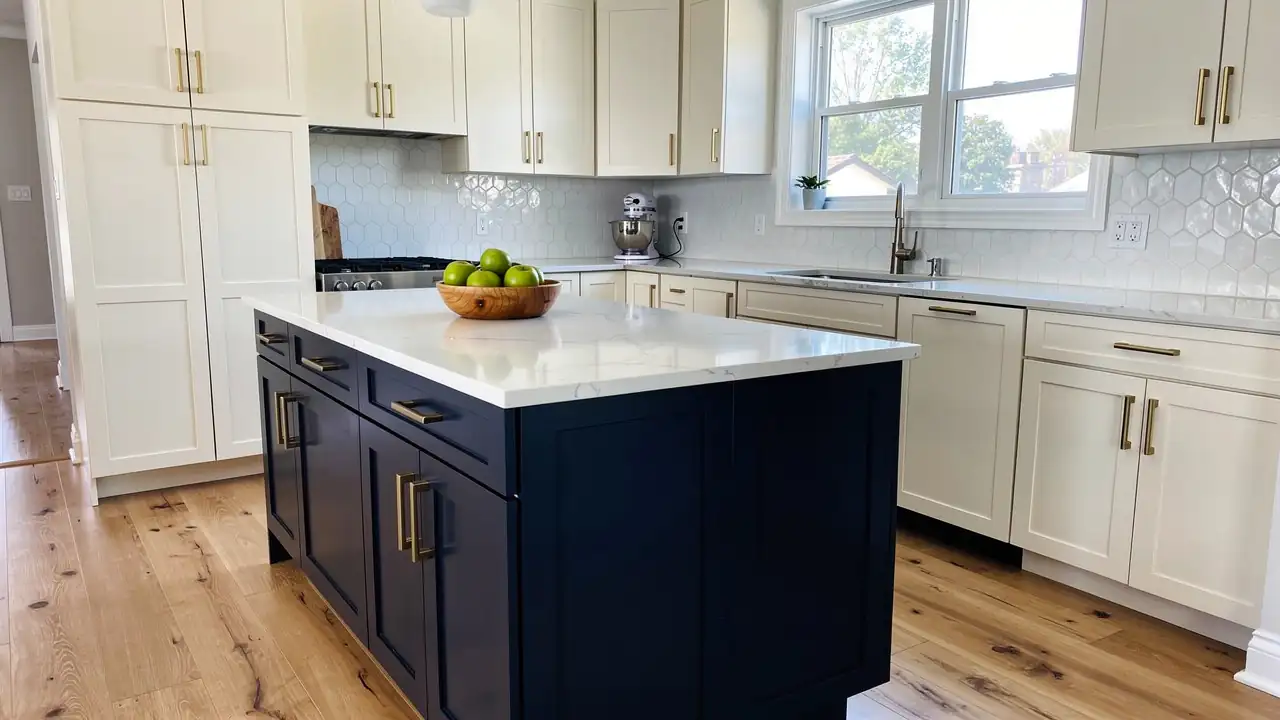
Perimeter in one colour, island in another: the most common two-tone layout and the least risky. The change happens across open floor, so there is no split line to get wrong, and it is the easiest layout to repaint later.
Two colours, one $250 flat fee
Kitchener Elite Cabinet Painting & Refinishing paints two-tone kitchens for homeowners in Kitchener and across Waterloo Region who want more depth than a single colour gives, without buying new cabinets. A contrasting island, dark lowers under light uppers or one tall pantry in an accent colour can change how the whole room reads.
The extra cost is small: a second colour adds $250 flat to the price of painting your kitchen. The real skill is deciding where one colour stops and the next begins, and keeping that line crisp.
Across 16+ years and more than 1,700 jobs we have paired cabinet colours with oak floors, quartz counters and north-facing windows, so we can tell you which combinations hold up in real Kitchener light.
What two-tone means
A two-tone kitchen uses two cabinet colours in one room, split by zone rather than scattered at random. We paint both colours in the same job, in our booth and on site, matched in sheen so the pair looks planned.
Two-tone tends to suit these kitchens best:
If only the island is changing, our kitchen island painting service handles it on its own in 2 days. For the whole room in two colours, the second colour is added to a full kitchen cabinet painting job.
Layouts
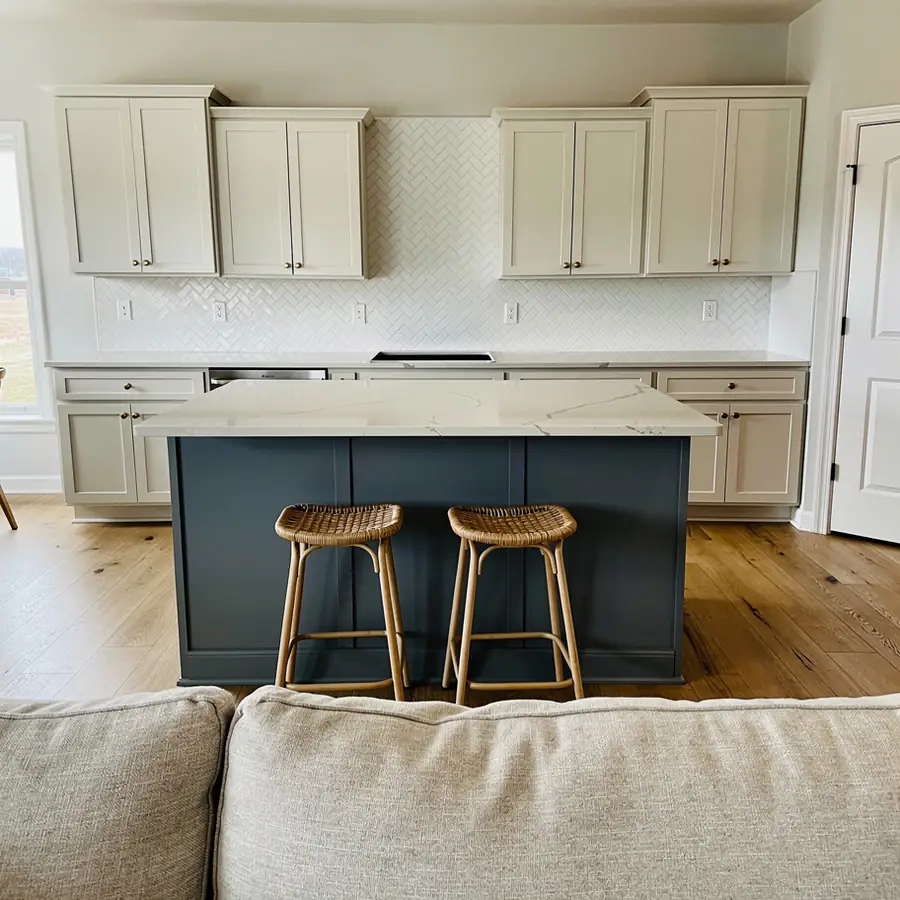
The safest two-tone layouts follow the architecture of the kitchen: the island, the line of the countertop or a single tall unit. Each one puts the colour change where your eye already expects a break.
Perimeter in one colour, island in another: the most common two-tone layout and the least risky. The change happens across open floor, so there is no split line to get wrong, and it is the easiest layout to repaint later.
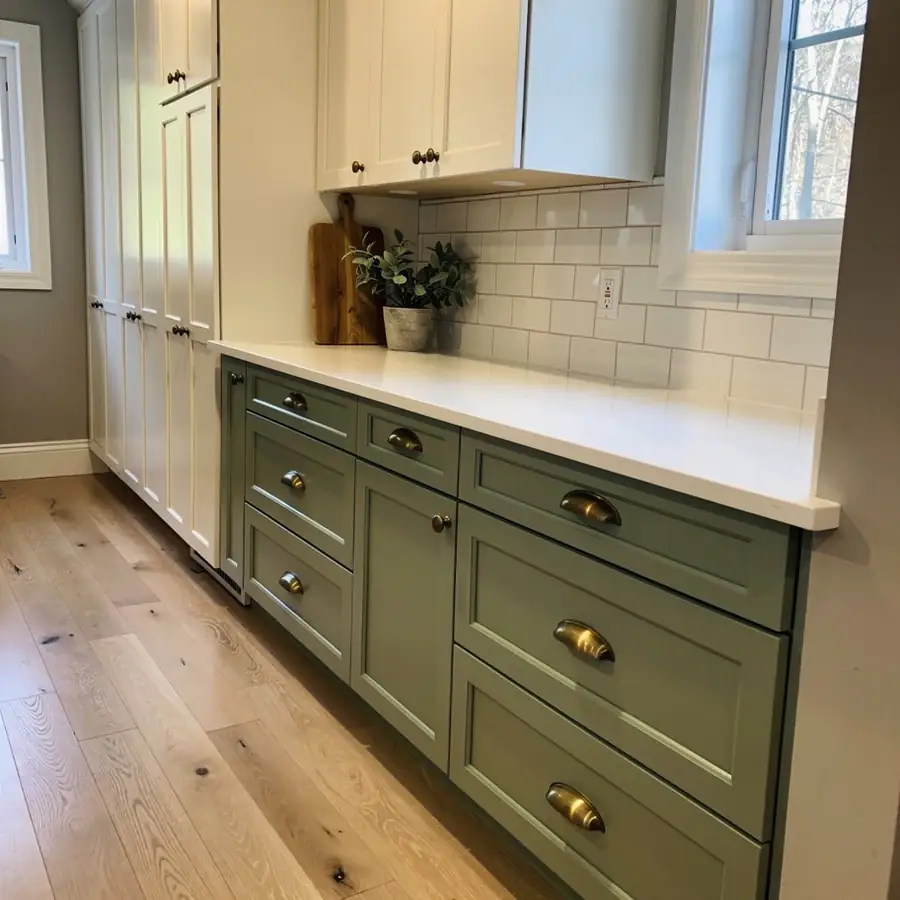
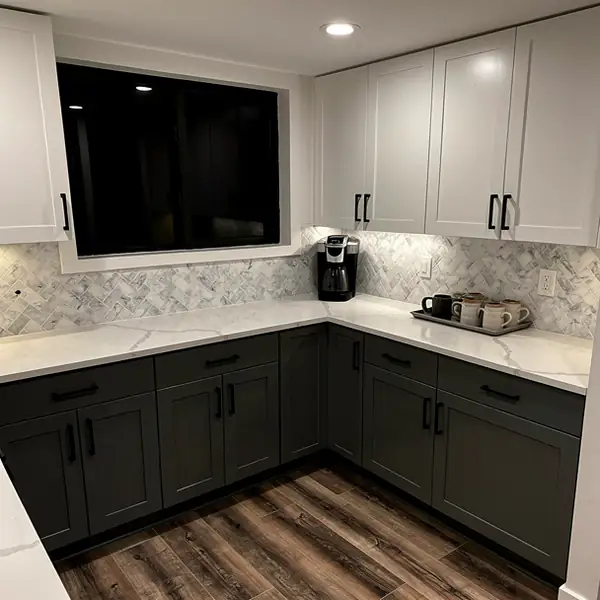
Darker base cabinets ground the room and hide toe-kick scuffs, while lighter uppers keep it bright at eye level. The countertop and backsplash form the natural split line between them.
Painted boxes beside natural wood floating shelves or a stained hood surround mix colour with warmth. We mask and protect the wood you are keeping, so only the cabinets change.
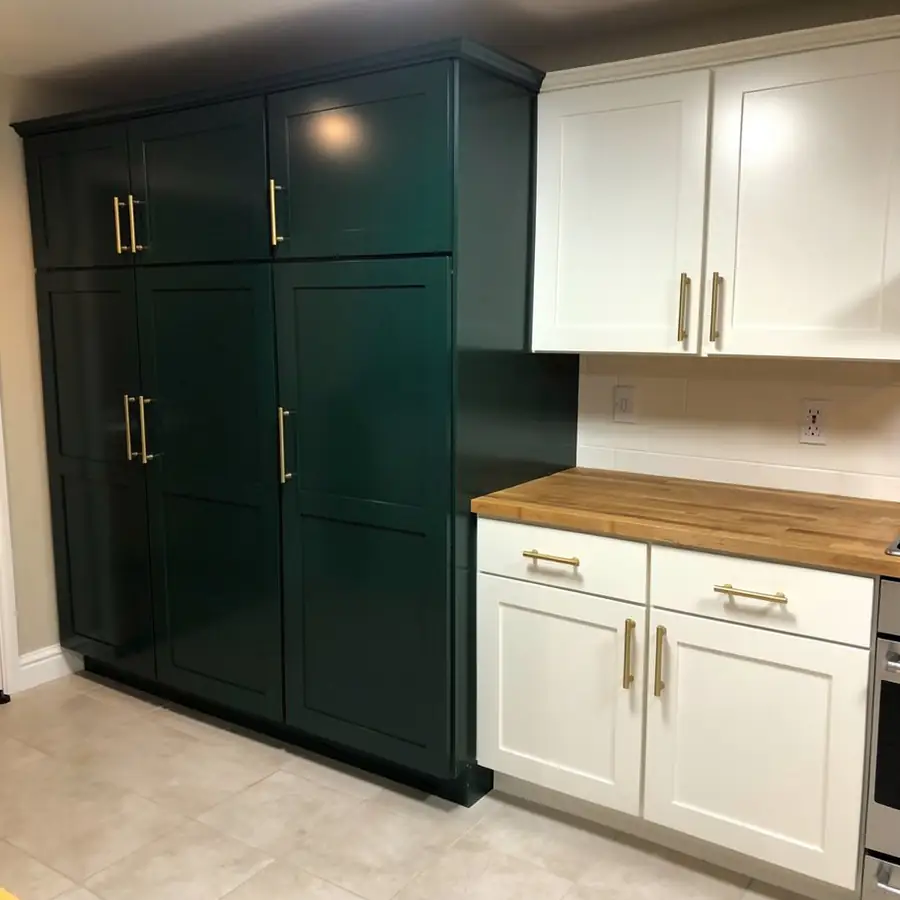
One tall feature, such as a pantry wall, coffee station or hutch, in a second colour gives a two-tone look with little risk of a busy room. Tall units have quirks of their own, covered by our pantry cabinet painting service.
The split
The split between two colours should always land on a natural break: the countertop, an inside corner, a face-frame joint or open floor. A colour change in the middle of a flat panel looks like a mistake, however neatly it is painted.
| Part of the kitchen | Where the colour changes |
|---|---|
| Island against perimeter | No line needed: the island is one colour, end panels, corbels and toe-kick included |
| Uppers against lowers | At the countertop, with the backsplash between the two colours |
| Tall pantry or fridge surround | The whole tall unit takes one colour, usually the lighter upper colour, so it is not cut in half |
| Peninsula | Treated as an island if it has seating, otherwise it follows the lowers |
| Crown moulding and light valance | Matches the uppers |
| Toe-kicks | Match the cabinets directly above them |
| End panel where both colours meet | At the face-frame joint or the inside corner, never mid-panel |
Colour pairings
Two cabinet colours belong together when they share an undertone and differ clearly in depth. A warm white beside a warm green works; a cool blue-white beside a warm beige-grey looks dingy, even if each is lovely on its own.
These pairings are dependable starting points:
Light changes everything. North-facing kitchens make cool colours look colder and south light warms them, so we spray sample boards of both colours for you to tape up and live with for a few days.
More shortlists by colour family are in our kitchen cabinet colours guide.
Behind the scenes
The prep on a two-tone kitchen is identical to a one-colour job; the spraying is what changes. The full sequence is set out in our cabinet painting process.
Both colours are sprayed in your chosen sheen and checked side by side in your kitchen before any door comes off.
Doors and drawer fronts are labelled by colour as well as position, so no upper door lands in the lower batch.
In the booth each colour of Renner 2K is its own batch, with the gun and lines flushed in between so the first colour never tints the second.
On site, where two colours meet on a box or end panel, we spray the lighter colour first, mask the cured edge with fine-line tape and then spray the darker one.
Pricing
A two-tone kitchen costs the same per-piece price as a one-colour kitchen, plus $250 flat for the second colour. For a typical medium kitchen of 21 to 35 pieces, that puts the total at about $3,650 to $5,450 before HST.
Rates for every kitchen size and extra are on our cabinet painting price list.
Typical jobs
Three common two-tone setups around Waterloo Region, with the prep, colours and price ranges they usually involve.
A 1980s oak kitchen of about 30 pieces gets Zinsser B-I-N against tannin bleed, White Dove on the perimeter and Hale Navy on the island. With the second colour it typically runs $3,650 to $5,450.
A 2000s maple kitchen of 40 or more pieces in Guelph with Evergreen Fog lowers and Alabaster uppers falls in the $5,200 to $7,800 large range, plus the $250 second colour.
A Waterloo kitchen of about 28 pieces with Iron Ore lowers, Pure White uppers and matte black pulls lands at $3,650 to $5,450, plus $6 per hole if the pulls move.
FAQ
The two-tone questions we hear most are about trends, which colour goes where and what happens if you change your mind later.
Some versions will. Bright colours scattered across random doors date fastest, while a contrast island or darker lowers in navy, green or charcoal have a long track record in kitchen design. The island approach is the easiest to undo, since repainting an island on its own costs $650 to $1,400.
Usually the lowers or the island. Dark colours belong low, where they ground the room and hide scuffs, and light colours belong high, where they reflect light; dark uppers over light lowers feel top-heavy in all but very tall, bright kitchens.
Yes, in most kitchens. One sheen across both colours, usually satin at about 25 to 35% gloss, makes the pair read as one finish.
Yes. Painted cabinets take a new colour well, so an island or the lower run can be repainted in a contrast colour years after the first job, using the same prep.
Colour consult
Send photos of your kitchen and the two colours you are weighing, or none at all, and we will send a written quote within 1 business day with a plan for where the split goes. Your colour consult includes sprayed sample boards of both colours.